Team building has a reputation problem. Many people associate it with awkward icebreakers and forced fun. Yet a well-chosen activity can do in three hours what months of meetings can't. The difference lies in the choice — and these seven questions will help you get it right.
1. What should the event achieve?
Define the goal before looking at activities. "Getting to know each other" calls for small, mixed teams and lots of interaction. "Celebrating the year" calls for something light and fun. "Working on how we collaborate" might need a debrief or a facilitated discussion afterwards. Write the goal down in one sentence and use it to filter every offer.
| Goal | Best fits in Berlin | Why |
|---|---|---|
| Getting to know each other, onboarding | Treasure hunt, cooking class | small mixed teams, lots of conversation |
| Improving collaboration | Escape room, treasure hunt | success only through communication and clear roles |
| Celebrating a success | Axe throwing, indoor karting | light, competitive fun with a social finale |
| Showing Berlin to international guests | Treasure hunt, Berlin Wall tour, bike tour | the main sights and the stories behind them |
| A relaxed reward after a busy period | Cooking class, street art walk | calm, social and easy for everyone |
2. How many people are coming?
Group size eliminates half the options immediately. An escape room works for 2–6 people per room; karting tracks have a limited number of karts; cooking schools have a limited number of stations. Formats in which the group is split into many teams playing in parallel — such as a treasure hunt — scale from 9 to several hundred participants without losing quality. More on this in our guide to team building for large groups in Berlin.
| Activity | Typical group | 50+ people? |
|---|---|---|
| Treasure hunt | 9–300 | ✅ Yes — teams play in parallel |
| Berlin Wall tour | any | ✅ Yes — with several guides |
| Escape rooms | 2–6 per room | ⚠️ Several rooms or shifts |
| Guided bike tour | up to 15 per guide | ⚠️ Several guides |
| Indoor karting | in heats | ⚠️ Waiting between heats |
| Axe throwing | small to large groups | ⚠️ In rounds |
| Cooking class | small to mid-size | ❌ Rarely |
3. Who is in the team?
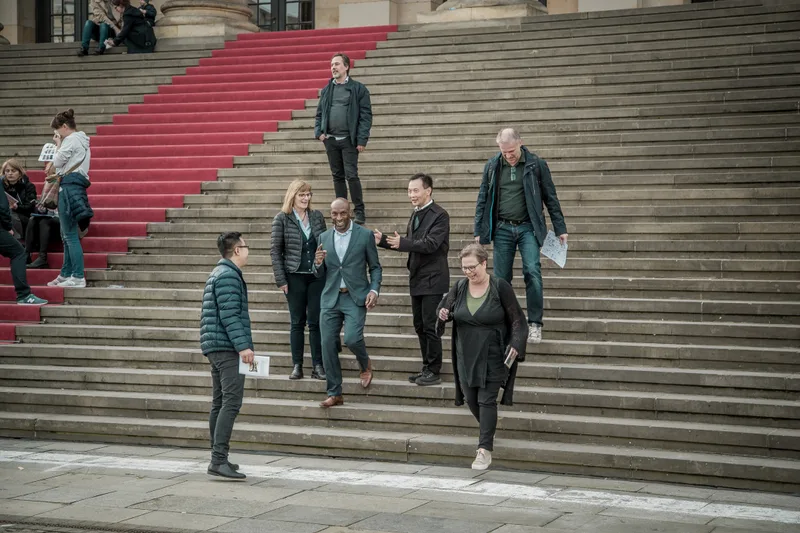
Consider age range, fitness, personality types and languages. If your group includes people in their twenties and in their sixties, avoid physically demanding activities. If half the team are introverts, avoid formats built on performing in front of others. And in international Berlin, where many teams mix local staff with colleagues flying in from abroad, check whether the programme can run in English — our treasure hunt runs in English or German, and mixed-language teams are no problem.
4. What is the realistic budget?
Compare the price per person including everything. A cheap activity with expensive extras is not cheap. Ask what is included, whether there is a minimum charge, and what the cancellation terms are. Payment after the event (no deposit) makes internal approval much easier.
For orientation, some Berlin prices (excl. VAT): a treasure hunt costs €590 per group for 9–25 people, €24 per person for 26–50 and €22 per person for 51+, with the Game Master, materials and prizes included. Guided bike tours start at €24 per person and a street art walk at $29 per person; escape rooms, cooking classes, karting and axe throwing are usually priced on request.
5. How much time do you have?
Most good team building activities take 2–3 hours. Shorter than that and the group barely warms up; longer and energy drops. For comparison: an escape room takes 60–90 minutes, a treasure hunt 2–3 hours including the briefing and award ceremony, and a cooking class 3–4 hours including the meal. If the event is part of a conference day, look for a format that can start at the venue and end at the dinner location — see our step-by-step planning guide.
6. Indoor or outdoor?
Outdoor activities are more memorable, indoor ones more predictable. In Berlin, outdoor formats work best from April to October, when days are long and temperatures pleasant; with a flexible route and the option to reschedule, they work all year round. Indoor options such as escape rooms, cooking classes, karting and axe throwing are independent of the weather. Read our comparison outdoor vs. indoor team building for details.
7. Does the activity require real collaboration?
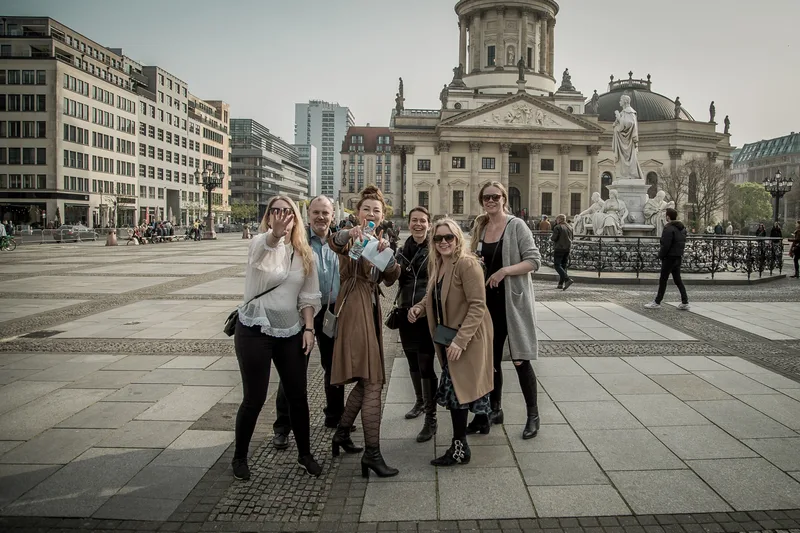
This is the question most people forget. Many "team" activities are really individual activities done in the same place — bowling, karting, a bar night. For a genuine team effect, choose a format where the team can only succeed by communicating, dividing roles and deciding together.
Research backs this up: Google’s Project Aristotle, a study of 180 teams, found that psychological safety — the feeling that everyone can speak up, try ideas and make mistakes — matters more for team effectiveness than who is on the team. Activities where every voice is needed to win build exactly that.
Quick checklist
| Question | Why it matters |
|---|---|
| Goal defined in one sentence? | Filters out unsuitable formats |
| Works for the whole group size? | Avoids splitting into separate events |
| Suitable for all ages and fitness levels? | Nobody stays on the sidelines |
| Available in the right language? | International teams feel included |
| Full cost per person known? | No surprises after the event |
| Weather plan B? | The event takes place no matter what |
| Requires real collaboration? | Actual team effect, not just fun |
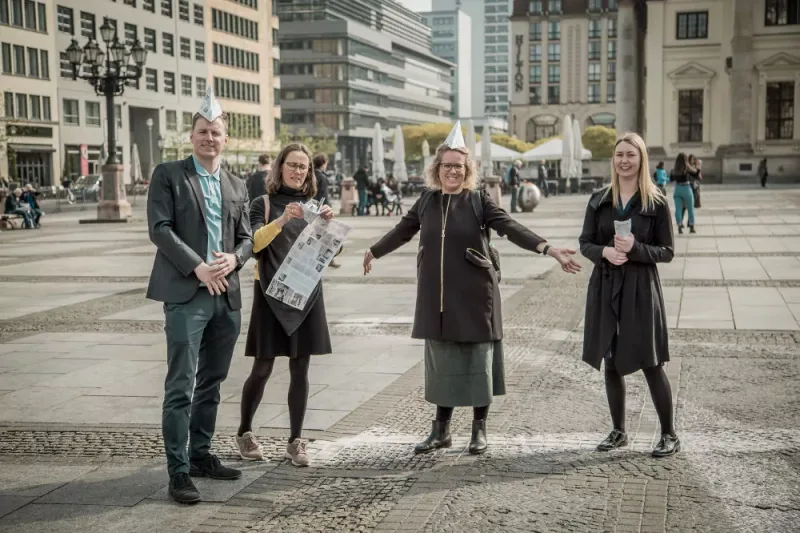
If you answered most of these questions with "small mixed teams, all fitness levels, 2–3 hours, outdoors in the city", a treasure hunt — an outdoor team building game in Berlin — is probably your best match. See our Berlin routes.